The NPQ Autumn 2026 applications are now open, click the link to apply and find out more!

Find out more about what an apprenticeship is, who is eligible, and funding options here.
An apprenticeship is a practical way to learn a job, or enhance your career, while earning a wage. It combines real work experience with structured training, allowing you to gain valuable skills, qualifications, and confidence in a chosen career.
As an apprentice, you are employed by a company and work as part of their team. You’ll learn hands-on, completing real tasks and developing skills specific to your role. At the same time, you’ll receive support and guidance from experienced colleagues and mentors, as well as Best Practice Network’s experienced team.


In England, most anyone can apply for an apprenticeship if they are 16 or over and not in any other form of education.
Apprenticeships are a great way to gain an industry recognised qualification and develop a rewarding career. They are cost free for the apprentice and provide an opportunity to earn while you learn.
Current staff can also utilise apprenticeships for their CPD, this is a cost-effective solution for schools to promote and train employees.
By using apprenticeships to upskill your existing staff, you are helping to fill key gaps in your business, improving staff retention and supporting their professional development.
 To be eligible for an apprenticeship the learner must have:
As an apprentice, you will not have to pay any money towards your course. You will need the support from your setting, who can access funds from the English apprenticeship levy fund.
Looking for your next steps?
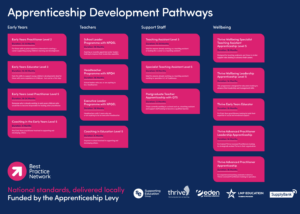
Choose from the following pathways to enhance your knowledge, skills and career!

The Apprenticeship Levy is a contribution required from employers with a pay bill exceeding £3 million. The English apprentice levy fund is controlled by the Department of Education and was created as a long-term funding solution for companies to hire and train apprentices.
The Apprenticeship Levy is paid into a central Apprenticeship Service account at a rate of 0.5% of the total annual pay bill. Employers manage their levy funds through their account dedicated to apprenticeship training expenditures.
While only larger organisations pay the Apprenticeship Levy, the funds it generates also support apprenticeship training for smaller employers interested in taking on apprentices.
• The Apprenticeship Levy is paid into the apprenticeship service account monthly
• You automatically receive a 10% contribution top-up from the government. Apprenticeship training can only be delivered by an approved training provider.
• Apprenticeship Levy funds can only be used to pay for training apprentices to achieve qualifications as part of an approved apprenticeship training programme
• Funds must be used within 24 months, or they expire (this is due to change to 12 months after August 2026).
Depending on how your school is managed, the Apprenticeship Levy will be held and accessed differently.
See below for more information and how to access your funds.
1. Academies and Multi-Academy Trusts
It is likely your trust will be your employer and they will pay into the Apprenticeship Levy.
Get in touch with your trust head office to see how much allocation is available. There may be a centralised apprenticeship strategy in place across the trust.
2. Voluntary-Aided Schools
If your governing body’s pay bill is over £3 million, they will pay into the Apprenticeship Levy. To access the funds, you’ll need to contact your governing body and see how much allocation is available. Some VA schools can access the levy via their local authority, this will need to be discussed with them directly, however, Best Practice Network can support these discussions.
3. Community and Voluntary Controlled Schools
Your MAT is likely to pay into the Apprenticeship Levy. Your MAT should let you know how much levy you have available to spend. If you’re unsure how to access the funds, contact your local authority to find out.
If your employer doesn’t pay into the Apprenticeship Levy, or there are not enough available funds, you can still use apprenticeships at your school with the co-investment option.
The government will pay for 95% of the programme fees while your employer or account holder co-invests the remaining 5%. This 5% is invoiced monthly over the duration of the programme.
Alternatively, if you or your school cannot access the Apprenticeship Levy, your apprenticeship training programmes can still be 100% funded by a levy transfer. Apprenticeships can be funded by an Apprenticeship Levy-paying employer transferring up to 50% of their levy to a different employer.
Transferred funds are used to pay for 100% of the training and assessment costs of the apprenticeship up to the funding band maximum.
Transferred funds cover the cost of the whole duration of the apprenticeship.
For guidance on how funding routes apply to your setting, speak to a Best Practice Network apprentice advisor on +44(0)117 920 9428 or email [email protected]
Did you find this page useful?