Coaching in Education Apprenticeship Level 5

The Coaching in Education Apprenticeship Level 5 offers staff in schools the opportunity to develop as confident, evidence-informed coaches - rooted in the realities of education.

http://Marches_School_Web-47-1200x960

Who is it for?

The Coaching in Education Apprenticeship Level 5 is designed for professionals across the education sector who are committed to supporting others through skilled, non-directive coaching.

Whether you work in a school, nursery, or multi-academy trust, this programme is for you if you are helping colleagues grow by facilitating reflection, encouraging ownership, and enabling change through coaching conversations.

You may already be applying coaching approaches informally or have some experience in a leadership role. This apprenticeship will deepen your coaching expertise, helping you create lasting impact through meaningful dialogue and developmental challenge.

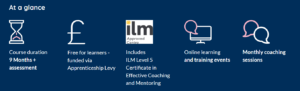
On completion, you will also achieve the ILM Level 5 Certificate in Effective Coaching and Mentoring—a nationally recognised qualification that enhances your coaching credibility across the education sector and beyond.

This apprenticeship is designed for:
  • Senior leaders, assistant heads, and others who use coaching to lead and empower their teams
  • Experienced teachers, phase or curriculum leaders, and room leaders fostering reflective practice
  • ITT and ECF mentors and facilitators looking to build advanced coaching capability
  • SEND and inclusion leads who want to use coaching to enable inclusive, sustainable staff development
  • Practitioners and childminders applying coaching principles to support peer growth
  • Anyone with coaching or mentoring experience who wants formal recognition through a funded, professional qualification

The Programme


This programme develops the knowledge, skills and behaviours needed to become an effective coach within education settings. It combines practical coaching practice with an understanding of organisational contexts, leadership approaches and personal development. Learners complete a structured programme of study, coaching practice, supervision and reflection.


Programme Content

Onboarding and induction: Initial assessment of training needs, guidance on support, and an introduction to the ILM Level 5 qualification requirements, roles and responsibilities, and study skills.

Understanding effective coaching and mentoring:

Undertaking Coaching in practice:

Reviewing your coaching ability:

Key duties and behaviours

Delivery

How is the Coaching in Education apprenticeship delivered?


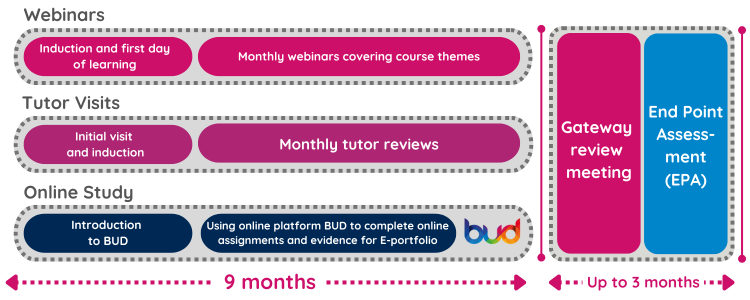
The Coaching in Education Apprenticeship is designed to be flexible and achievable alongside full-time work. Delivery combines expert-led sessions, tailored support and access to a range of high-quality online resources. You’ll benefit from:

  • Monthly online classrooms – live, interactive sessions that build your coaching knowledge and skills over time
  • Monthly 1:1 sessions with your dedicated Tutor-Coach – personalised support, progress reviews and targeted development
  • Three-monthly tripartite reviews – joint meetings between you, your employer and your Tutor-Coach to review progress, set goals and ensure alignment with your role

You’ll also have access to a wealth of on-demand online resources, tools and activities to support your learning throughout the programme.


Why should schools support staff to complete this apprenticeship?


  • Apprentices also gain the ILM Level 5 Certificate in Effective Coaching and Mentoring. This well-respected qualification demonstrates their coaching knowledge and skills to a nationally recognised standard
  • Embed a consistent coaching culture: Apprentices bring structured coaching techniques (like contracting and active listening) into daily practice, encouraging growth across the whole setting
  • Support inclusion and SEND provision: Coaches trained in emotional intelligence and bias awareness are better equipped to guide staff in inclusive practice—supporting diverse learners and colleagues
  • Enable staff to solve real problems: With coaching grounded in goal-setting, evaluation, and reflective practice, your staff can tackle issues such as performance, staff workload, or transitions with clarity and confidence
  • Strengthen professional standards and ethics: Apprentices leave settings assured in legal, ethical, and safeguarding expectations—building trust among staff and stakeholders
  • Drive leadership capacity from within: Participants gain stakeholder management skills and the ability to coach senior colleagues—bolstering leadership pipelines without needing external support
  • Produce evidence of coaching impact: With measurable frameworks (e.g., ROI theories) embedded in practice, your setting will have concrete proof of improvement for external reviews and inspections

Did you find this page useful?